Sept/Oct 2022 Health & Fitness
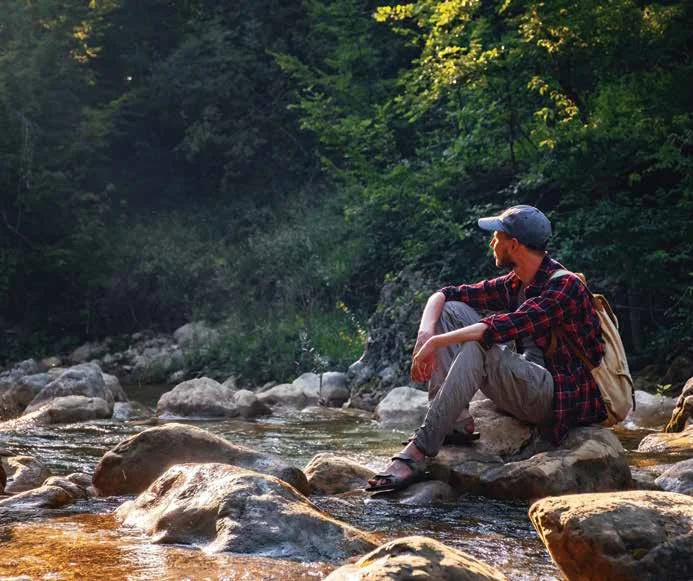
"We can't hurry our way to slowness and buy our way to attentiveness," writes author Leath Tonino. instead, try just sitting on a rock. Photo: Adobe Stock
The Do-Nothing Itinerary Have You Ever Headed Into the Woods With No Agenda? Try it.
By Leath Tonino
On a recent Sunday morning, after pancakes and coffee and more coffee, I set out for the Little Otter Creek Wildlife Management Area with an empty backpack slung over my shoulder. By empty, I mean empty: no raincoat, no granola bar, no distracting book, no beeping phone. Common sense says to leave an itinerary on the kitchen table when you bushwack solo, in case of emergency, but my plan was an anti-plan, my itinerary a blank sheet of paper.
Really, what could I write?
Gonna tromp into the woods, maybe walk a game trail, probably end up staring at a bed of moss or a spider web for a couple hours, definitely hunker in a thicket and listen to chirping birds until I've entirely forgotten that I'm listening. Gonna do nothing, do the place, stop doing, stop scheming, get bored, get slack-jawed, get lost and found. Be back sometime before sunset.
Such micro-excursions require only a cushion (the empty backpack laid across damp ground, gnarled roots, a lichened boulder, whatever's available) and a willingness to sit, to adventure into aimlessness, to experiment with wu-wei.
That's an idea (nay, an ideal) central to the lives of my heroes, the rivers-and-mountains poets of ancient China, guys who balanced their ambitious careers as government bureaucrats with contemplative retreats.
Following another stressed-out session in the offices of the capitol, they would hightail it to a country estate to gaze at a forested slope's thousand shades of green, to sip just enough wine to let go and drift with the wispy clouds, to temporarily inhabit the spaces underneath their thoughts (where poetry resides). According to translator-scholar David Hinton-a fellow Vermonter-wu-wei is a "rich philosophical concept" that defies encapsulation, but basically it points towards acting "spontaneously," without "self-conscious intention."
Picture a molted raptor feather or a coyote's pawprint catching my eye.
Picture me pausing, crouching, cocking my ear to a whispering voice: "Take a load off, sonnyboy. This is the spot."
Okay, but also picture me struggling to hear that voice, to heed the call of a world larger than my own agendas and designs. Despite the empty pack, I typically carry something immaterial yet heavy to the woods: the intention to be intentionless, the goal of being goalless, the desire to renounce desire and thereby allow surprising details-leaves, polished pebbles, chipmunks, wasp nests-to rush (spontaneously!) into my oft-cluttered headspace.
Big Pharma, Big Ag, Big... Wellness? Increasingly, chilling out and opening oneself to the world is bottled and sold, the perennial wisdom of wu-wei turned into apps, online mindfulness exercises, slick books, digital detox resorts, on and on and on. It's understandable that this would occur-that a $120-billion-a-year business would arise to meet the needs of a populace addicted to busyness and productivity-and I have no doubt that in many instances the new products and prescriptions are exactly what the doctor ordered.
(CDC data shows that the number of meditating Americans tripled from 2012 to 2018, and scientific studies indicate that meditation can lower blood pressure and cortisol levels, not to mention boost focus, resilience, and happiness.)
Fine. But personally, I'm distrustful of quick fixes and programs dangling price tags. They tend to involve a sneaky kind of doing, an insidious kind of reaching and striving and wanting. Pretty much anything that treats non-intentional loafing as utilitarian-Do Non-Doing And You'll Generate Extra Energy For The Stuff That Actually Matters!-strikes me as crazy. In my experience (I began reading the ancient Chinese poets and wandering in the woods twenty years ago, at the tender age of sixteen), we can't hurry our way to slowness and buy our way to attentiveness. Seems to me that endurance, a decidedly uncomfortable and awkward bearing-with, is the most reliable tool (anti-tool?) in our kit.
Which loops us around to that recent Sunday foray into the exterior wilds of the Little Otter WMA and the interior wilds of wu-wei-wilds that are still strange and foreign even after all these years. By noon (judged by the sun because I don't wear a watch), I had wadded the empty backpack under my fanny and plopped down in a nondescript patch of weeds at the base of a half-dead white pine. "Nondescript" is relative, of course, and incrementally the details of the site revealed themselves: the textures and tones, the complex choreography of shapes and colors.
I noticed patterns in bark. I noticed the glint of an ant's armor. I noticed that my butt was numb. I noticed that I was frustrated with the lack of direction, irked with the tedium of a radically slomo pace. And I noticed, eventually, that I'd stopped noticing, that I'd been subtly transformed from actor to acted-upon, that I was calm and grinning and-whoa, it was already evening.
Nothing happened. Everything happened. Nature happened. But it took endurance-the same endurance I draw on to climb peaks, bike hilly gravel roads, kayak the length of lakes, and ski through bitter cold storms-to arrive there.
To arrive where?
A blank white sheet of paper on the kitchen table hums with uncertainty, with possibility, with simplicity.
To arrive where we are. Nuff said.
Contributing editor Leath Tonino is the author of The Animal One Thousand Miles Long: Seven Lengths of Vermont and Other Adventures and The West Will Swallow You. This essay originally appeared in the Sept/Oct issue of 2022.