March 2026 / ATHLETE PROFILE

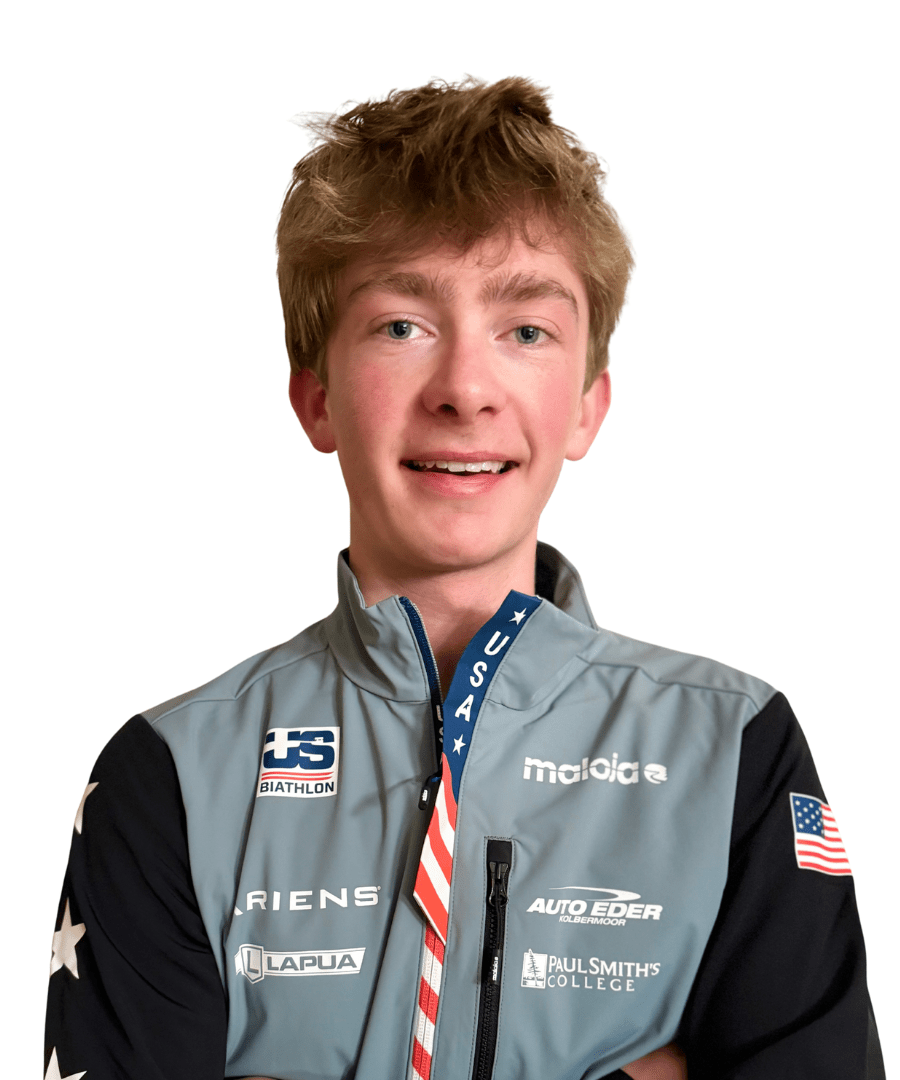

Seven Bowen, Taylor Carlson,
and Virginia Cobb
Competing at the Biathlon Junior World Championships
By Phyl Newbeck
Seven Bowen, Taylor Carlson and Virginia Cobb are all members of the US Junior Biathlon team, but they have more than that in common. All three athletes are also members of the Ethan Allen Biathlon Club and all three are from Chittenden County. Bowen lives in Huntington, Carlson is a Jericho native, and Cobb hails from Westford. The Vermont trio attend different colleges, but they have trained together at the Ethan Allen Firing Range and will make up almost half of the US Junior biathletes at the World Championships in Arber, Germany in February 25-March 8.
The youngest of the trio at 18, Seven Bowen grew up in Reading, VT but moved to Huntington in eighth grade. Before high school, her skiing consisted entirely of alpine and backcountry. “I didn’t start Nordic skiing until ninth grade,” she said. “I had never been on groomed trails or skate skis before.” She credits the Mansfield Nordic Club for teaching her the sport. During summer training she noticed that her teammate Virginia Cobb was leaving practice early to go shoot and was intrigued. Virginia introduced her to the coach of the Ethan Allen Biathlon Club and she was hooked. “I’d grown up hunting,” she said, “so I was familiar with that part, and everyone was super great.”
Taylor Carlson has been told that he was one-year-old when he first strapped on skis at Sun Valley, Idaho. The 19-year-old was born in Salt Lake City but moved to Jericho, VT when he was three. In third grade he started skiing with the Manfield Nordic Club at the Ethan Allen Firing Range. At the age of 12, after seeing some of his older friends shoot, he started biathlon training, as well. He had never held a gun before. Throughout high school he raced with the club, as well as with the Mount Mansfield Union High School Nordic team while competing in biathlon with EABC.
At 20, Virginia Cobb is the oldest of the group. Growing up in Westford, VT as part of an athletic family, she started skiing as soon as she could walk. An older brother did biathlon, so when she was 12, Virginia went to an introductory camp and at 15 began training at the range. She attended Essex High School which did not have a serious Nordic ski team (they practiced on the soccer field), a contrast to the experience of Seven and Taylor, but like them she raced with the Mansfield Nordic Club.
Seven at 2025 Junior Cup in Germany. Chris Campbell
Seven said that her strength is the 7.5K sprint although she has been improving at the longer distances. She is most proud of a race in Poland which was part of the International Biathlon Union Junior Cup. She finished 38TH in the sprint. “I fought really hard and prepared really well and was really focused,” she said.
Virginia is partial to distance racing. She has been to the Junior World Championships four times and at her first experience in Kazakhstan, she was 16th in the sprint race. “I was 16 years old, so it was pretty exciting that I had such a good result,” she said. “I didn’t have any expectations because it was my first Junior Worlds and it was the first time shooting had really clicked for me.” Virginia noted that some of the guys on the team medaled, which made the event even more fun.
Like Virginia, Taylor is partial to longer races with his favorite event being the 12.5K mass start which has four shooting stations. He is proud of a race last December which allowed him to qualify for the World Championship. “The second race was a mass start 12.5K and that was my best biathlon race,” he said. “My shooting was a lot tighter, and I’d been skiing well from Nordic racing.”
All three athletes attend college in the Northeast. Seven and Taylor are first year students at Williams and Bates colleges, respectively, while Virginia is a sophomore at Dartmouth. All three race for their college Nordic teams but none of them have access to a biathlon course. Seven keeps her rifle at Prospect Mountain in Woodford, where the team trains but she is only allowed to dry fire. “It’s not ideal,” she said, “but it’s better than nothing.” Virginia is able to keep her rifle on campus so she can occasionally practice dry firing. The mother of a local biathlete has a house in nearby Etna with a target in the backyard, but Virginia has not been able to get there as often as she would like. That’s okay because she believes shooting isn’t necessarily linear; you can just as easily do well after time off as be rusty. Taylor is the only one of the three who isn’t allowed to bring his rifle to campus, but he practices shooting when he comes home to Vermont. The week before the World Championship is school vacation so he’ll have time to practice at the Ethan Allen Firing Range.
Taylor at Craftsbury Outdoor Center, VT. Philip Belina
The Junior World Championship doesn’t coincide with any school break, but Seven said her professors have all been very understanding about her need to take time off. She doesn’t have to declare a major until the end of her sophomore year and is thinking about pre-med. Virginia has just declared neuroscience as her major. She said she is lucky that most of her professors record their classes or are willing to share notes with her so she can keep current with her studies. Taylor said that taking time off for competitions is harder in college than it was in high school, but his ski coach and the school athletic director have been helping him navigate the logistics. “It’s not super uncommon for Nordic skiers to take time off,” he said. Taylor hasn’t declared his major but is looking towards earth and climate science with a minor in chemistry.
The US is not exactly a biathlon powerhouse. In fact, biathlon is the only Winter Olympic sport where the US has not won a single medal. The 2026 fifth place finish in the men’s 4x7.5K relay at Milan Cortina was the highest result ever for the team.
Seven has several theories for why biathlon isn’t popular in the US. For one thing, in other countries it is part of their culture which is not the case here. “You have to be a somewhat privileged person who lives in a cold place,” she said, “and that eliminates a lot of athletes.” Seven also noted that the way the education system works in the US, athletes have to decide in college whether to proceed with a sport, leave for a job, or graduate school. She has not decided what she will do.
Taylor has been amazed that even in Vermont where Nordic skiing is popular, a lot of people aren’t familiar with biathlon. “In Europe, everyone watches the events,” he said. “I’ve heard that a higher percentage of Germans watch biathlon than Americans watch football.” That disparity means it is hard for American athletes to find funding or support. Like Seven, Taylor is unsure whether he’ll continue as a competitor after he ages out of the Junior level in two years. At that point, there are fewer international options and the competition is stiffer. He is considering joining a professional team after graduation
Virginia at 2024 Junior World Championships in Estonia.
Virginia believes biathlon isn’t well known in the US, partly due to weather constraints but also because there aren’t many shooting ranges. She concedes that if she hadn’t grown up so close to the Ethan Allen Firing Range, she probably wouldn’t have known anything about the sport.
This will be her last year at the Junior level, and she is also trying to figure out whether to continue in biathlon. “At school I’m mostly just a skier,” she said. “It’s hard to find time to practice. Europeans do it all year either at sports schools or simply not going to school. They are on a different level. The situation here isn’t ideal but if I have a good day, I can hold my own.” After aging out of the Junior ranks, Virginia will continue to race for Dartmouth and might consider taking a year or two off after graduation to focus on biathlon.
Seven was homeschooled until high school so she didn’t realize she had a competitive side until she took up cross-country running during her freshman year of high school. “Even in practice, whenever I’m in a situation with others, I’ve found that I’m a competitive person,” she said. “Every time I finish a race I think about how I could have done better.”
“I’ve been in love with Nordic skiing my whole life,” Taylor said, “but the shooting aspect makes it more interesting.” He noted that often the same racers win Nordic races year after year but there is more variety on the podium for biathlon events. “Even if you’re not skiing your best you can still do well if your shooting is good so that adds a whole new aspect,” he said.
Virginia had never shot a gun before she started biathlon and is happy that her shooting has improved. She considers biathlon to be a rewarding sport because of the difficulty of being good at both parts of the event. “It’s addictive to try to do better,” she said. Virginia also enjoys the lifestyle of training and being outside. “Ski racing without biathlon is fun,” she said “but you can spend a lot of time analyzing things. There’s more going on in biathlon than just a ski race. It’s definitely more engaging.”
“I really like biathlon because I just love seeing how hard I can push myself,” Seven said. “Some people think I’m a little crazy for that. The best feeling in the world is to cross the finish line and before seeing results to know that you had a good race because you prepared well, shot well, and pushed as hard as you could. You’ve almost dead but you know you had a good race. I’m always fighting for that feeling.”
Although the three athletes have trained together, in the winter they only see each other as competitors, as they ski for their respective colleges. They will reunite as teammates in Germany. “I was excited that we all made the team,” said Virginia. “I feel really lucky that I was in the EABC when I was because it was a really great group of people.
You can usually find Phyl Newbeck outdoors, cycling, swimming and kayaking, and skiing and skating in winter. She moved to Jericho in 1995 and although still a flatlander, she stacks a mean woodpile. Phyl (vtphyl72@gmail.com) has written for regional newspapers and magazines and is the author of Virginia Hasn’t Always Been for Lovers: Interracial Marriage Bans and the Case of Richard and Mildred Loving.