March 2026 / COMMUNITY
Stowe Mountain Heritage Race (skimo) at Stowe Mountain Resort. Mike Oliver and Maria Goodwin
Norwegian Ski Badge event at Ethan Allen Firing Range in Jericho. Marcus Tracy
Vermont’s Mountain Battalion
Norwegian Ski Badge and Stowe Heritage Race
By Nathan Fry
This winter, Vermont’s 3rd Battalion, 172nd Infantry Mountain Infantry Regiment (aka the “Mountain Battalion”) is earning their turns and solidifying their reputation as the US Army’s oldest and most capable mountain operations unit.
Over the first weekend in March, Vermont’s own mountain soldiers pushed their cold-weather skills from training lane to race course, linking a Norwegian Military Ski Badge event at Ethan Allen Firing Range in Jericho with the civilian-focused Stowe Mountain Heritage Race. The battalion’s Alpha Company was the element on the snow for the Norwegian Ski Badge, but the effort is part of a broader battalion-level push to reclaim and refine the winter mountain warfare culture that has defined the Mountain Battalion for decades.
A Mountain Battalion with Deep Roots
The Mountain Battalion traces its modern lineage to 1982, when its first companies were formed to help rebuild the Army’s light infantry capability in winter and mountain warfare after the post-World War II disbandment of the original 10th Mountain Division. From the beginning, it was intended to be different: lighter, more mobile, and at home in steep, cold terrain that slowed or stopped conventional units.
Throughout the 1980s and 1990s, soldiers of the Mountain Battalion trained with the 173rd Airborne Brigade, Italian Alpini troops in the Dolomites, the reactivated 10th Mountain Division at Fort Drum, and instructors at the U.S. Army Mountain Warfare School, which shares the same Vermont hillsides the battalion now calls home. Those relationships forged a culture where rope teams, steep snow, and long ski approaches were not exotic challenges but standard operating procedure.
Then came the post9/11 era. Over two decades, the battalion’s focus shifted to deployments and contingency missions. Companies rotated through Iraq in 2005, Afghanistan in 2010, and the Arabian Peninsula in 2021, while also supporting multiple multinational exercises in places like North Macedonia. The demands of counterinsurgency, urban operations, and advising missions pushed winter mobility to the margins. The mountains never stopped being part of the unit’s identity, but they were no longer the daily training problem.
Today, as the Army reorients toward combat operations in contested, harsh environments, the Mountain Battalion is deliberately turning back to its roots. Skiing, cold-weather survival, and movement in technical terrain are no longer niche skills. They are core tasks.
Norwegian Ski Badge event at Ethan Allen Firing Range in Jericho. Marcus Tracy
The Norwegian Ski Badge Comes to Ethan Allen – Alpha Company carried that intent onto the snow at Ethan Allen Firing Range, where it conducted what is believed to be the first formal Norwegian Military Ski Badge event hosted by a unit outside the Norwegian Armed Forces. With approval from the Royal Norwegian Embassy, 14 soldiers set out to meet a foreign standard on home terrain.
The Norwegian Ski Badge is not a morale patch handed out at the lodge. It is a military proficiency badge that demands 18 miles of skiing while carrying a weapon and a ruck weighing at least 24 pounds. The course must cover varied terrain, and the event culminates in a full rifle qualification, forcing soldiers to control their breathing and steady their aim after hours of work on skis. It is equal parts endurance test, technical evaluation, and mental gut check.
To host the event, Alpha Company and the battalion staff had to do more than just plot a long loop on a snowy map. They submitted a detailed operations plan to the Royal Norwegian Embassy’s defense attaché office, validating that their distance, elevation, equipment lists, uniform configuration, time standards, environmental considerations, and safety protocols all met Norwegian requirements. The resulting course turned Ethan Allen’s training lanes into a true Scandinavian-style military ski test, rather than a local approximation.
“For our soldiers, skiing isn’t just a badge to earn – it’s a core mountain skill and part of who we are as a company,” said First Sergeant Robin Fitch-McCullough, of Alpha Company. “When you put a ruck on their backs and send them across snow and mountains as a team, you build toughness, trust and confidence. Events like this sharpen our edge, strengthen our cohesion, and make our soldiers ready for whatever mission comes next.”
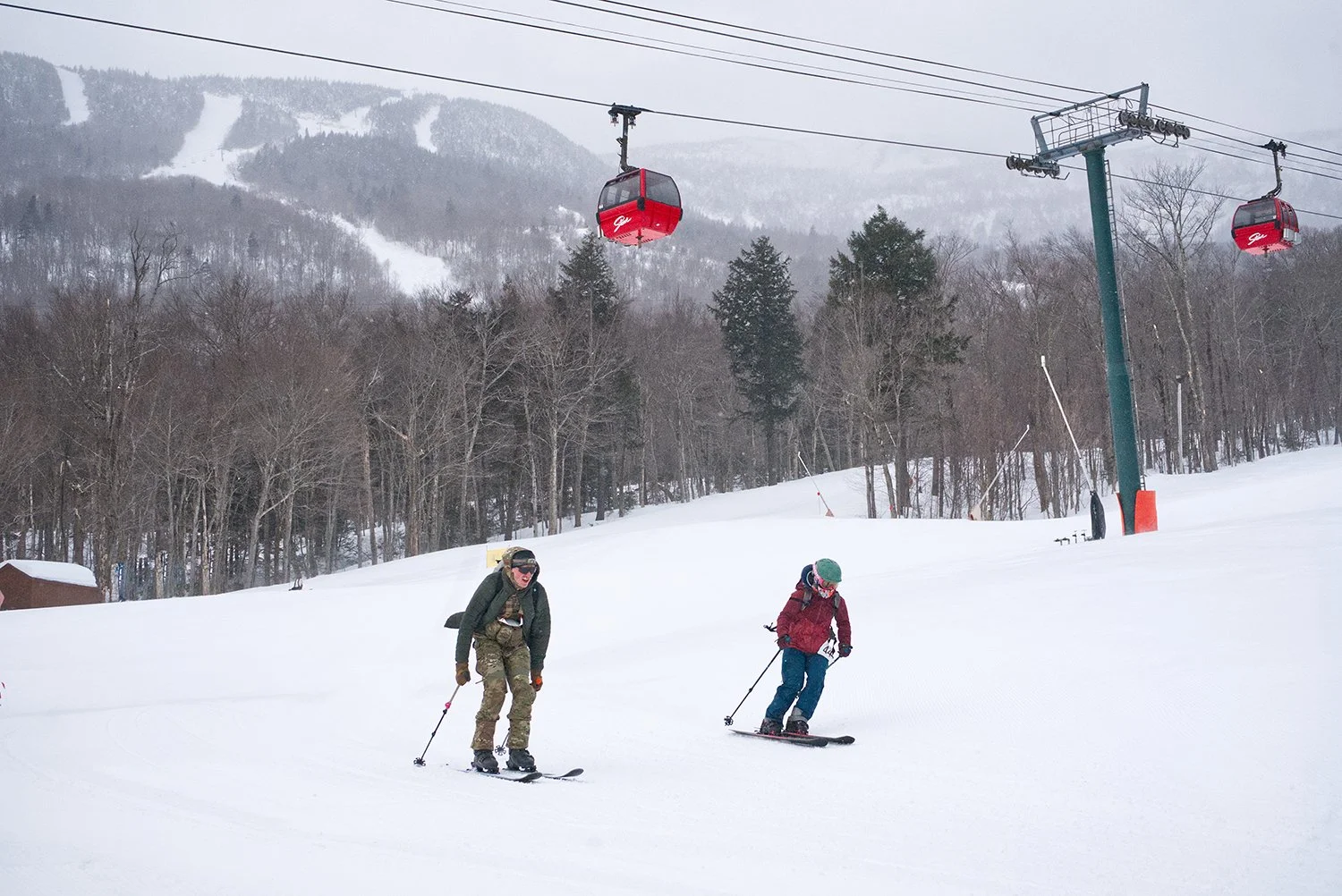
Stowe Mountain Heritage Race (skimo) at Stowe Mountain Resort. Mike Oliver and Maria Goodwin
Training to Perform on Snow – Within the Mountain Battalion, there are lifelong skiers who grew up on Vermont’s lift lines and skin tracks as well as soldiers who arrive having never stood in bindings. The battalion’s winter training models cater to both. Drill weekends turn into onsnow laboratories, where novice skiers learn to snowplow and side-slip under the eye of more experienced teammates, and seasoned skiers refine kick turns, skinning efficiency, and load management on longer movements.
“Strengthening our winter and mountain warfare skills is central to our mission, and it’s an honor for our unit to compete for the prestigious Norwegian Ski Badge,” said Captain Aaron Hildebrand, Alpha Company commander. “Many of these soldiers are preparing to deploy this year, and events like this strengthen both their physical endurance and mental resilience.”
Once the skis were racked and the qualification targets scored, Alpha Company compiled the event statistics and documentation required by the Norwegian standard. Those records now form part of a growing institutional memory of winter performance that the battalion can build on in coming years
From Training Lanes to Heritage Race – Many of the same soldiers who earned or attempted the Norwegian Ski Badge clipped back into skis for the Stowe Mountain Heritage Race, a skimo race that threads together the historic ski terrain of Stowe.
The SMHR is inspired by the legacy of Stowe as the birthplace of both the National Ski Patrol and the 10th Mountain Division, shaped largely by the vision of Charles Minot “Minnie” Dole, founder of the division. Where the Norwegian Ski Badge is a strictly prescribed military test, the Heritage Race is its civilian cousin: a fast, community event that still demands serious fitness and technical skill. This year’s race was organized as a partnership between the National Guard Association of Vermont and Stowe Mountain Rescue, both of which can trace their lineage back to the 10th Mountain and National Ski Patrol stories: one through the 3-172 Infantry (Mountain), the other through decades of professional mountain rescue on the same slopes and gullies where Minnie Dole first skied.
Eleven Miles and 4,000 Feet of History – The SMHR course is designed as a moving history lesson in Vermont skiing. Racers covered about 11 miles and 4,000 feet of elevation gain, weaving through the Ranch Valley’s Bruce Trail, climbing into the classic Nosedive and Perry Merrill runs, traversing the austere walls of Smugglers’ Notch, and descending the Snuffy’s backcountry ski trail into Spruce Peak Lodge. It is a route that showcases the best terrain of the Stowe valley and challenges racers to balance uphill speed with downhill stamina.
On paper, the Heritage Race is straightforward: climb, transition, descend, repeat. On snow, it is a test of skin track efficiency, edging on firm traverses, rapid transitions in cold wind, and downhill composure on zapped legs. Those demands mirror the battalion’s winter training focus. The same habits of movement techniques, pacing, and self-care that keep a soldier moving forward under a ruck during a long Norwegian Ski Badge push translate directly to a race environment where the mountain environment and a running clock are the main adversaries.
One Team, One Community, One Race – Seventy racers lined up for this year’s Stowe Mountain Heritage Race. Nineteen were military members or veterans, and roughly three-quarters of that group currently serve in the 3-172 Infantry (Mountain). That presence gave the field a distinct mountain infantry flavor – guard soldiers in mixed military and civilian gear stood alongside experienced skimo athletes from as far away as Colorado, local backcountry regulars, and weekend skiers looking to test themselves on terrain they usually only descend.
For the battalion, the race provided something no internal training event can fully replicate – a direct skills comparison with civilian experts. Loads were lighter and rifles stayed home, but the core requirement to move efficiently in steep, variable winter terrain remained the same. For some soldiers, keeping pace with established ski mountaineers confirmed that the battalion’s renewed emphasis on winter proficiency is paying off. For others, the race became a benchmark, a first taste of the performance ceiling they can reach with more time on skins and skis.
Vermont’s Unique Military Mountaineering Culture – Seen together, the Norwegian Ski Badge at Ethan Allen and the Stowe Mountain Heritage Race form a continuum that runs straight through the identity of the 3-172 Mountain Infantry. On one end lies a foreign military standard, validated by a European ally and executed under strict conditions. On the other lies a community race that celebrates Minnie Dole’s vision, the birth of the National Ski Patrol, and the 10th Mountain Division’s legacy in American skiing. The battalion sits in the overlap.
For the Mountain Battalion, the objective is not star performance at a single event. It is the steady rebuilding of a culture where deep snow, cold wind, and long climbs are not obstacles but familiar terrain. Whether on a Norwegian-standard course at Ethan Allen or a storied downhill ski run in Stowe, the battalion is working to ensure that, when the mission goes uphill and the temperature drops, Vermont’s Mountain Battalion is ready to perform.
Nathan Fry (nathan.fry13@gmail.com) is a ski mountaineer, entrepreneur, and current commander of the Mountain Battalion. He is proud to serve alongside the finest mountaineers that the US military has to offer. Nathan lives in Hinesburg with his family and spends as much time possible walking uphill to ski downhill.